


Table of Contents
Introduction: The Fatal Disconnect
Across the United States, policymakers and economic development agencies are investing billions to attract new industries—microchip plants, biomanufacturing hubs, data centers, renewable energy facilities—yet they’re discovering an inconvenient truth: you can’t have economic development without workforce development.
Communities are chasing factories without training the people who will work in them. They’re recruiting companies before preparing the teachers, apprentices, and students who will sustain them. The result is a widening gap between economic ambition and human capacity—an imbalance that threatens to derail the nation’s reshoring and revitalization efforts.
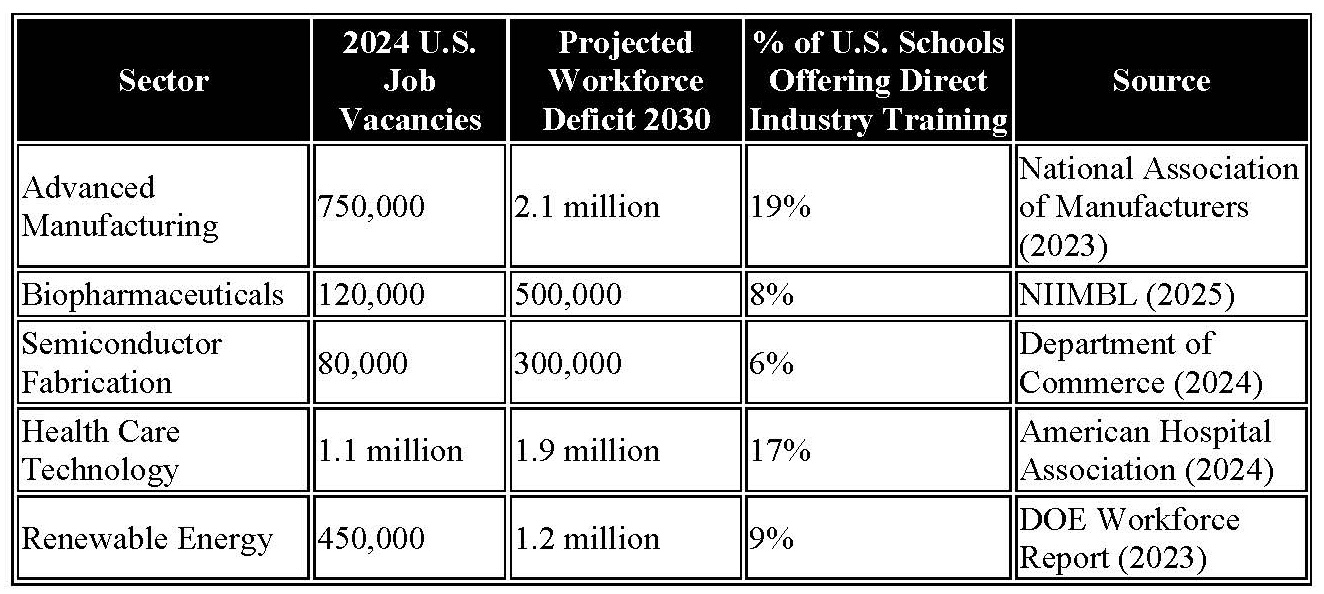
According to the U.S. Chamber of Commerce (2024), there are 8.8 million job openings in the United States, and only 6.3 million unemployed workers. The Bureau of Labor Statistics (2024) projects that by 2030, the U.S. will face a deficit of more than 3.4 million skilled technical workers, particularly in science, engineering, biomanufacturing, health care, and advanced manufacturing.
This is not just a labor issue. It is an economic crisis that undermines sustainability, national security, and competitiveness. The solution lies in building concurrent, co-located systems of workforce and economic development—a model where education, industry, and community development operate as one ecosystem rather than as separate bureaucracies.
Table 1: The Workforce–Industry Imbalance
Why Economic Development Alone Fails
Communities desperate for economic revival often compete to lure major employers with tax incentives, land grants, and promises of improved infrastructure. However, without parallel investment in human infrastructure—such as training pipelines, apprenticeships, and credentialing systems—these projects often stall or fail.
A 2023 Brookings Institution study found that 68% of U.S. counties that secured new manufacturing investments between 2015 and 2020 were unable to fill their projected workforce needs within three years of opening. Many had to import workers from other states or nations, defeating the purpose of local development.
Economic development without workforce development creates dependency; workforce development without economic development creates frustration.
To succeed, both must be designed as one integrated economic–educational ecosystem.
The Workforce–Economic Development Ecosystem Model
This model requires structural change. Schools, industries, universities, and government entities must collaborate not sequentially, but simultaneously.
- Co-Located Learning and Industry
Education moves into industry facilities. Factories, labs, hospitals, and data centers serve as the new classrooms—fully equipped, cost-efficient, and authentic. - Master Apprenticeships
Expert-led, paid apprenticeship models ensure skill mastery and career progression, thereby bridging the gap between education and employment. - Micro-Credentials and University Integration
Skills learned on-site translate into stackable digital credentials recognized by higher education systems. - Economic Incentives for Industry Educators
Industry experts remain in their fields but serve as mentors and instructors through formalized credential programs. - Community and Civic Integration
Governance, entrepreneurship, and public service education are closely tied to local industries, fostering regional sustainability and self-sufficiency.
Real-World Case Studies: Success and Failure
1. Intel’s Semiconductor Plant, New Albany, Ohio – The Cost of a Missing Workforce
Intel’s $20 billion “Silicon Heartland” project promised 3,000 high-paying jobs and sparked a regional economic boom. However, construction delays persist because the region lacks sufficient numbers of trained semiconductor technicians. Local schools place a strong emphasis on traditional academics, and nearby colleges have limited capacity for programs specific to semiconductors (Reuters, 2024).
Lesson: Economic development without simultaneous workforce planning leads to stagnation. The infrastructure was ready; the people were not.
2. Volkswagen Academy, Chattanooga, Tennessee – Industry-Led Education at Work
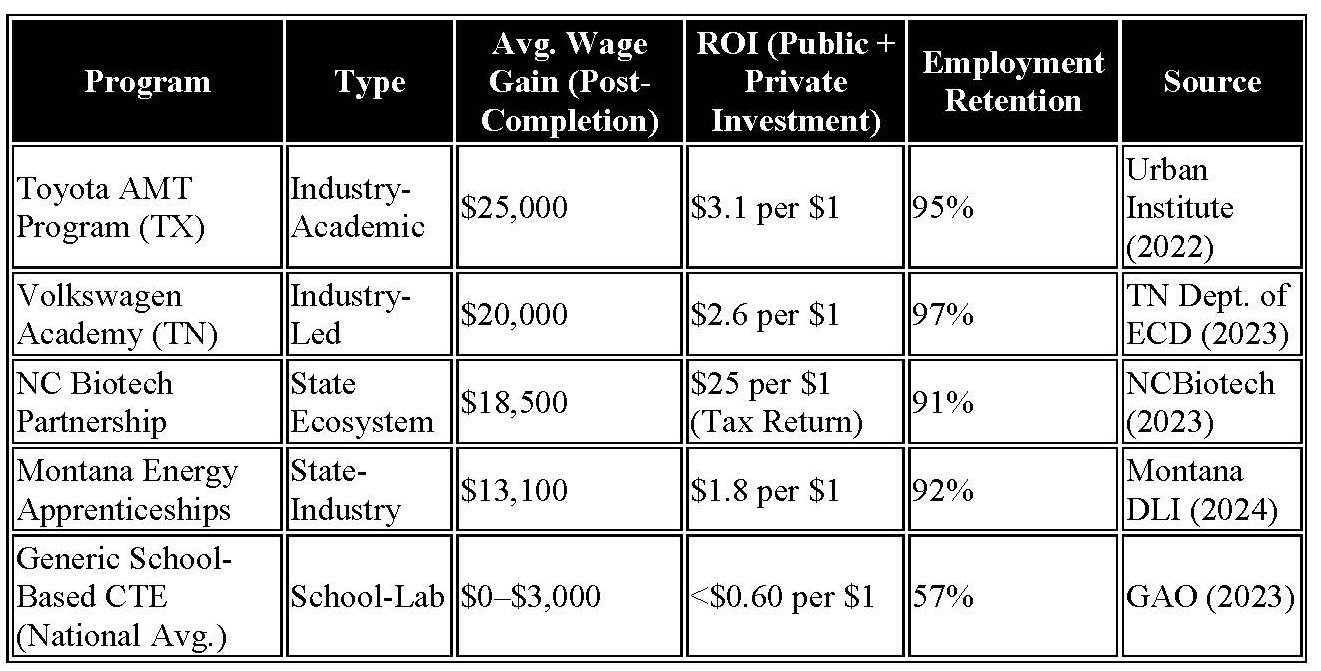
Volkswagen built its own academy adjacent to its manufacturing plant, integrating classrooms, labs, and production lines. High school and college students train under master technicians and earn credentials through Chattanooga State Community College. The program has achieved a 97% job placement rate, and graduates earn $65,000 to $85,000 annually (Tennessee Department of Economic and Community Development, 2023).
Lesson: Embedding workforce training within industry transforms education into a profit center, not a cost center.
3. North Carolina’s Biomanufacturing Ecosystem – A Model for the Nation
Through a partnership among the North Carolina Biotech Center, local universities, and industry, the state has created an ecosystem that links workforce and economic development. Students train in real biomanufacturing environments and earn stackable credentials validated by NIIMBL and community colleges. Over 10,000 technicians have been trained in five years, fueling $4 billion in biotech investment (North Carolina Biotech Center, 2023).
Lesson: When education and economic development are integrated, investment follows—and stays.
4. Texas Advanced Manufacturing Technician Program (AMT) – Industry–Education Integration
A collaboration between Toyota, the Federation for Advanced Manufacturing Education (FAME), and Texas high schools, AMT allows students to split time between school and paid factory work. Graduates earn associate degrees debt-free and transition immediately into $70,000 jobs with benefits (Urban Institute, 2022).
Lesson: Concurrent education and employment create loyalty, stability, and immediate economic return.
5. Montana’s Energy and Infrastructure Apprenticeships – Rural Sustainability
Facing an exodus of young workers, Montana restructured its CTE and apprenticeship programs to partner directly with energy, mining, and infrastructure firms. Apprentices earn micro-credentials that ladder into university degrees. The Montana Department of Labor (2024) reports an average wage increase of $13,100 one year post-completion and a 92% employment retention rate.
Lesson: Rural regions can achieve sustainability and sovereignty by integrating industry, education, and community development into a single, self-sustaining ecosystem.
The Economic Logic
According to the Urban Institute (2022), every $1 invested in apprenticeship partnerships yields a $1.44 return in increased productivity and reduced turnover. Employers lower recruitment costs, and communities expand tax bases through higher wages and stable employment.
When industry-based learning is integrated into economic development zones, public and private investment multiplies. The North Carolina Biotech model alone produced $400 million in annual state tax revenue from a $15 million annual investment—a 2,500% ROI (North Carolina Biotech Center, 2023).
Table 2: ROI of Integrated Workforce–Economic Development Models
The Human Factor: Why the System Must Change
The old education system assumes that schools produce graduates and industries hire them. But in reality, both systems now move at different speeds. Technology evolves in months, while school curricula change over years. Teachers are underpaid and overburdened, and even as schools distribute laptops, most lack the proficiency or confidence to integrate technology into learning effectively.
Generational resistance makes it worse. Veteran teachers often avoid technology because it wasn’t how they were taught. Teacher colleges, designed for 20th-century pedagogy, often fail to prepare educators for data-driven or industry-integrated instruction. Meanwhile, working parents cannot afford four- to six-year degree programs that require tuition, travel, and time they don’t have.
A 2024 Lumina Foundation study found that 64% of adult learners leave higher education within two years due to family and financial strain. The modern parent-worker-student cannot survive in the traditional model.
The only sustainable system is one that merges education with the workplace itself—a factory-school model where learning, earning, and living occur in the same ecosystem.
A New Definition of Development
Workforce development is economic development. They are two sides of the same coin.
- Workforce development creates people who can sustain economies.
- Economic development creates jobs that sustain people.
- When designed together, they create ecosystems that sustain nations.
Communities that align education, workforce, and industry do more than create jobs—they create stability, innovation, and sovereignty. They build self-sufficient regional economies capable of weathering global shocks, supply chain disruptions, and technological revolutions.
The National Imperative
This is not optional. It is existential.
If America fails to synchronize workforce and economic development, reshoring efforts will collapse under the weight of labor shortages. The Department of Commerce (2024) has already warned that workforce gaps threaten the CHIPS and Science Act, clean energy transitions, and the expansion of biomedical manufacturing.
Conversely, if we integrate industry-based education, credentialing, and master-apprenticeship models within regional economic plans, the results are transformative:
- Higher productivity
- Lower unemployment
- Increased local tax revenue
- Reduced public assistance
- Stronger national defense readiness
Conclusion: The Solution Is in Our Backyard
The schools are already here. The industries are already here. The facilities are already built. The experts are already employed. What’s missing is integration—the will to design systems where learning happens in the same places that drive the economy.
A modernized workforce–economic ecosystem does not separate classrooms from factories or universities from communities. It binds them together. It is the only model capable of producing a self-sustaining, profitable, and sovereign economy.
If America wants to lead the 21st century, it must stop treating workforce and economic development as separate goals. They share a single mission—and our future depends on it.
References
American Hospital Association. (2024). Health care workforce trends and shortages report 2024. Washington, DC: AHA Research.
Bureau of Labor Statistics. (2024). Employment projections for technical occupations, 2024–2030. Washington, DC: U.S. Department of Labor.
Brookings Institution. (2023). Manufacturing investment and regional workforce readiness study.
Washington, DC.
Department of Commerce. (2024). Reshoring and domestic capacity workforce strategy report. Washington, DC.
Lumina Foundation. (2024). Today’s student: Adult learners balancing work, family, and education. Indianapolis, IN.
Montana Department of Labor & Industry. (2024). Registered apprenticeship report 2024.
Helena, MT.
National Association of Manufacturers. (2023). Manufacturing workforce and productivity report 2023. Washington, DC.
North Carolina Biotech Center. (2023). Biomanufacturing workforce readiness report. Research Triangle Park, NC.
Reuters. (2024, March 8). Intel delays Ohio chip plant over shortage of skilled U.S. workers.
Tennessee Department of Economic and Community Development. (2023). Volkswagen Academy workforce outcomes report. Nashville, TN.
Urban Institute. (2022). Do employers earn positive returns to investments in apprenticeship? Findings from the American Apprenticeship Initiative. Washington, DC.
U.S. Chamber of Commerce. (2024). Workforce trends and skills shortage analysis 2024. Washington, DC.