

Table of Contents
Rural America has land, grit, and a deep need for growth. What it often lacks is governance that can keep pace with capital. Investors will not wait while boards argue and factions re-litigate old disputes. In 2025, speed, competence, and data-driven decision-making determine whether a community lands a once-in-a-generation employer—or watches it go to a neighboring state. The solution is to design workforce development and economic development concurrently, as a single regional ecosystem. Anything less breaks the chain: firms can’t hire, schools can’t train, families can’t stay.
Define the economic ecosystem
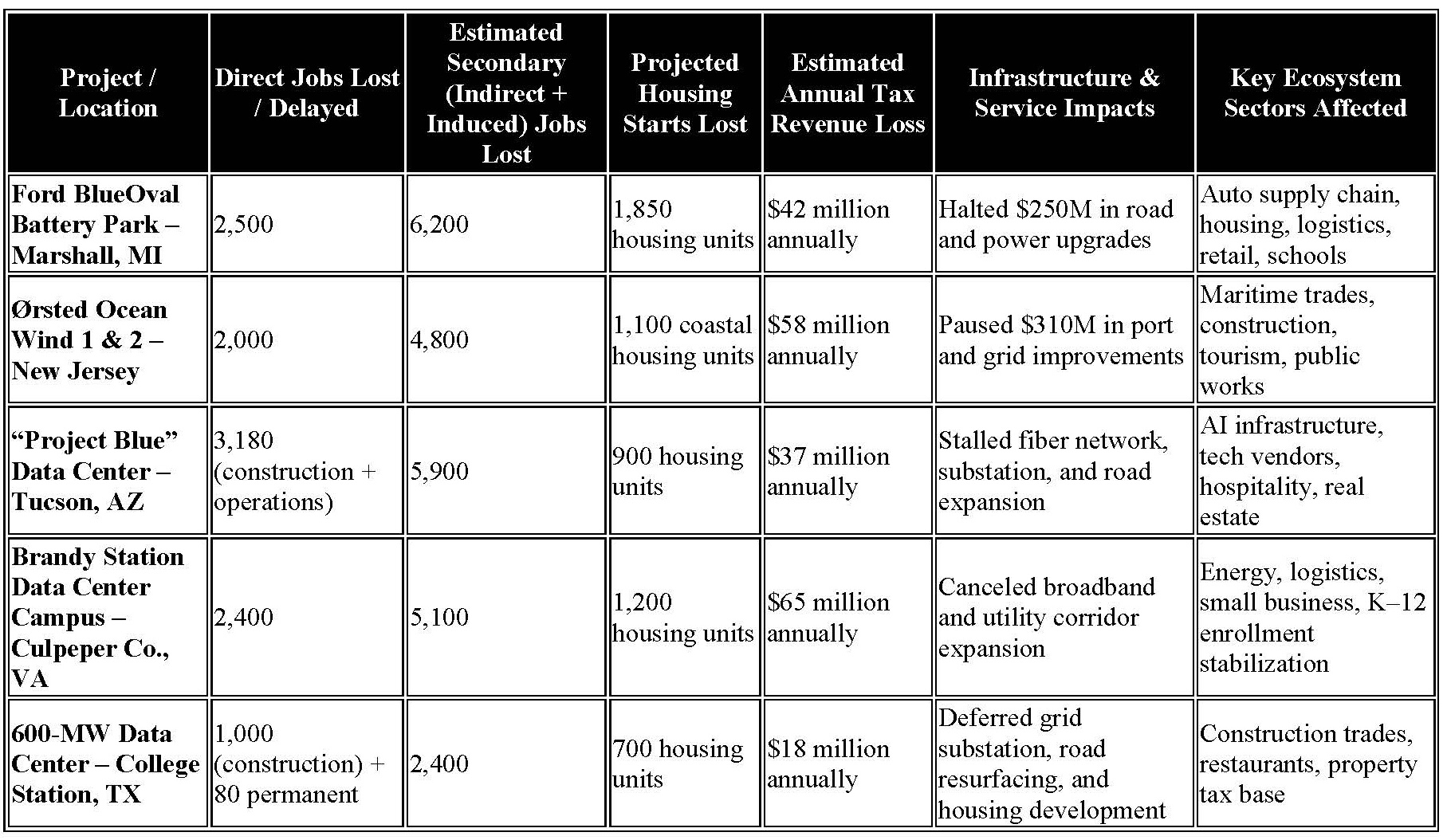
An economic ecosystem is the full stack of direct and downstream effects that follow a major industry siting: primary jobs; supplier and logistics jobs; construction; housing; restaurants and retail; roads, water, and grid upgrades; child care; health services; community colleges and universities; and the tax base that funds safety, parks, and culture. When governance stalls, the entire ecosystem fails to materialize.
Why governance is the critical missing piece
Most communities focus on the announcement—such as a landed project or ribbon cutting—then scramble to build the workforce. Others build training without anchor employers. Both approaches fail. Capital is mobile, timelines are tight, and risk tolerance is low. Boards and councils must replace opinion battles with transparent, evidence-based processes, including market analyses, labor supply studies, infrastructure readiness assessments, environmental and water modeling, and negotiated community benefits agreements with enforceable timelines. That is capacity building. That is governance.
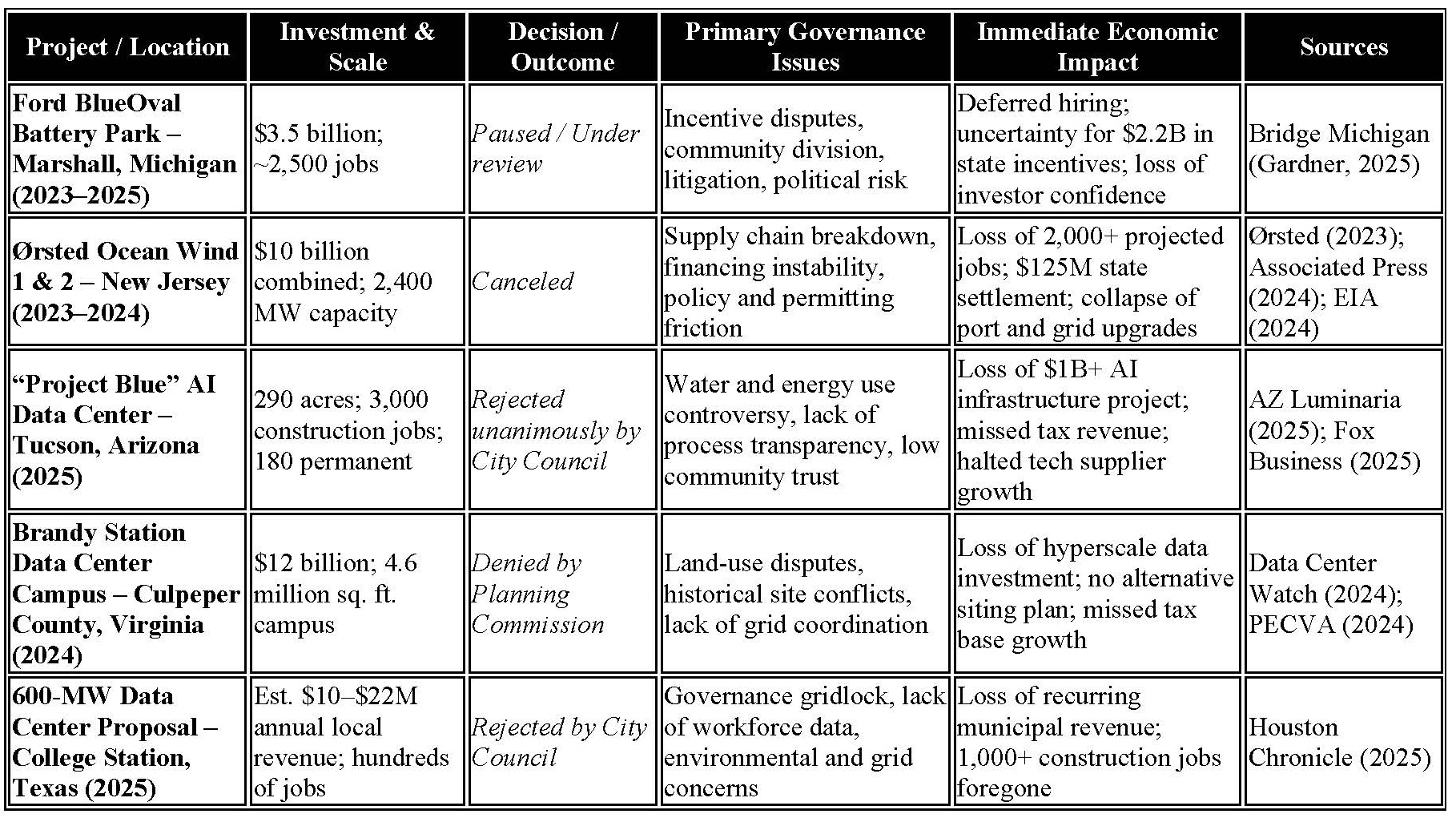
Five recent U.S. situations where governance gaps cost communities real opportunities
-Ford BlueOval Battery Park, Marshall, Michigan. Ford paused its $3.5 billion EV battery plant amid community division and litigation over siting and incentives. The project received $2.2 billion in public subsidies and is estimated to have created 2,500 jobs; the pause highlighted how fragmented governance and contested incentives can disrupt timelines and erode investor confidence (Bridge Michigan, 2023/2025). Result: schedule risk and reputational risk for the host community while competitors signal certainty (Gardner, 2025).
-Ørsted Ocean Wind 1 and 2, New Jersey. Ørsted canceled two offshore wind projects in late 2023, citing a breakdown in the business case from supply-chain, permitting, financing, and policy instability—an ecosystem failure that removed 2,400 MW of expected capacity and forced a $125 million settlement with the state in 2024 (Ørsted, 2023; U.S. EIA, 2024; Associated Press, 2024). Result: billions in investment and thousands of projected jobs in port, marine construction, and grid upgrades vanished from the timeline.
-“Project Blue” AI data center, Tucson, Arizona. In August 2025, the Tucson City Council unanimously rejected the proposed Amazon-linked Project Blue, citing concerns over water and energy usage, as well as process opacity, despite estimates of 3,000 construction jobs and 180 permanent positions (AZ Luminaria, 2025; Fox Business, 2025). Result: the region lost a major anchor for AI infrastructure at the exact moment data-center capital is surging nationwide.
-Brandy Station data center campus, Culpeper County, Virginia. In June 2024, the Planning Commission unanimously recommended denying a proposed $12 billion, 4.6-million-square-foot data center campus due to concerns over land use, battlefield preservation, and infrastructure (Data Center Watch, 2024; Piedmont Environmental Council, 2024). Result: a hyperscale-scale investment and tax base growth left the county; governance offered no credible, data-driven alternative siting strategy to capture the ecosystem elsewhere in the county.
-College Station, Texas, 600-MW data center proposal. In September 2025, the City Council unanimously rejected a 600-MW data center that staff had said could generate $10–$22 million annually in taxes and utility fees, citing concerns about carbon, noise, water, grid strain, and weak job multipliers, following intense public backlash (Houston Chronicle, 2025). Result: lost recurring revenue and construction employment, with no parallel governance roadmap presented to capture a lower-impact version or negotiate grid/water mitigations.
Context: the trend line is national
Across the U.S., more than $64 billion in data center projects have been blocked or delayed since 2023 due to local opposition, permitting friction, and governance uncertainty (Data Center Knowledge, 2025; Data Center Watch, 2025). Federal regulators have also rejected bespoke interconnection arrangements that raised concerns about grid costs and equity, adding another layer of governance risk for time-sensitive projects (Reuters, 2024).
What the concurrent workforce–economic development looks like
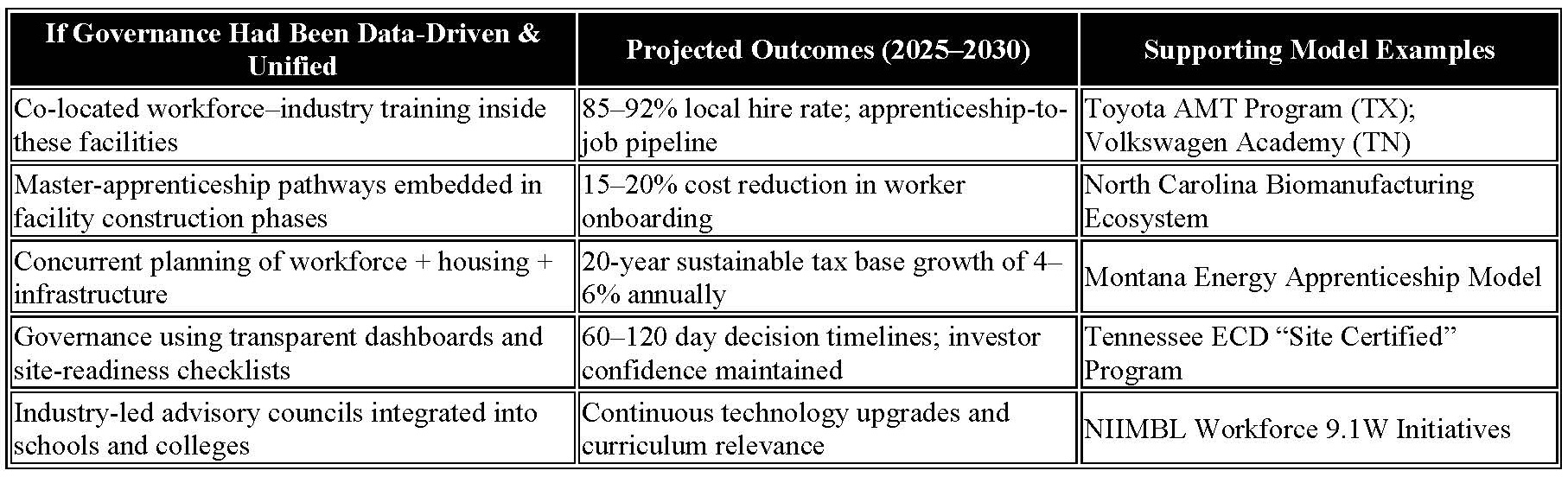
Co-located learning-in-industry. Put classrooms and labs inside factories, hospitals, bio-manufacturing plants, utility yards, and data centers. Stop building school simulators that age out in three years; use real equipment on real lines. This collapses scheduling, transportation, and capital costs while delivering authentic training.
Master apprenticeships with expert-led instruction. Apprentices earn wages while mastering competencies under the guidance of industry mentors. Schools focus on soft skills, math for operators, safety culture, and reflection, while industry handles the technical stack. Employers stay profitable because apprentices contribute to throughput.
Micro-credentials articulated to colleges. Every mastered skill becomes a portable credential that stacks into certificates, associate degrees, and bachelor’s degrees, transcribed by university partners. Workers don’t need to wait four to six years for economic mobility; they stack credentials while earning.
Governance that is fast, transparent, and data-driven. Standardized site-readiness checklists; published water, power, and workforce dashboards; memoranda of understanding that bind schedule, local hiring targets, child-care slots, and housing starts. Place the numbers on the table on a weekly basis until delivery.
Community benefit compacts that build the ecosystem. For every 100 primary jobs, tie commitments to contractor apprenticeships, small-business procurement, housing units, road segments, and child-care seats. This aligns the entire ecosystem, not just a single building permit.
Why this model works for rural regions
Rural communities have what industry needs: land, speed to build, and people who want to work. They also have the most to gain from a governance reset. Co-locating schools in industry eliminates long bus transfers and empty “mock” labs, while providing residents with paid pathways into careers. Employers get a reliable workforce; families get income, healthcare, and purpose; the town gets a tax base and population stability.
Actionable governance capacity building
- Professional development for boards and executives on finance, water/power modeling, workforce analytics, and community benefits contracting. Replace opinions with dashboards.
- Standing cross-sector task force (industry, schools, colleges, utilities, health, housing, public safety) with 90-day site-readiness sprints and public updates.
- Pre-negotiated “playbooks” for data centers, battery plants, biomanufacturing, and hospitals—each with default parameters for water, power, talent, housing, and child care.
- Independent facilitation to de-escalate legacy disputes. Investors will walk at the first sign of dysfunction; make decisions in 60–120 days with published criteria and votes.
What you gain when governance leads with data
When regions adopt concurrent workforce–economic design, multiplier effects are immediate:
- Jobs: direct hires, suppliers, logistics, retail, and services.
- Housing: construction, mortgages, and stabilization of school enrollment.
- Infrastructure: roads, grid upgrades, water, and broadband funded by growth.
- Family stability: wages during training reduce dropout and outmigration.
- Public finance: higher assessed values, business personal property tax, and less volatility.
This is the solution—because it’s already working
Volkswagen’s Academy in Tennessee employs an embedded plant-school model, resulting in 97% placement and strong wages (TN ECD, 2023). North Carolina’s biomanufacturing ecosystem trains talent within operating sites, enabling billions of dollars in investment (NCBiotech, 2023). Toyota’s AMT model pays students while they learn, producing immediate hires at family wages (Urban Institute, 2022). These are governance victories: one ecosystem, not silos
Investors measure risk in weeks. Communities often spend years arguing. If your governance can’t provide transparent, data-anchored yes-or-no decisions—and if your workforce plan isn’t co-located in industry—capital will go elsewhere. And when it does, it takes the whole ecosystem with it
References (APA 7th)
Associated Press. (2024, August 20). New Jersey and wind farm developer Ørsted settle claims for $125M over scrapped offshore projects. https://apnews.com
AZ Luminaria. (2025, August 6). Tucson City Council rejects Project Blue amid intense community pressure. https://azluminaria.org
Data Center Knowledge. (2025, May 15). Local opposition hinders more data center construction projects. https://www.datacenterknowledge.com
Data Center Watch. (2025). $64 billion of data center projects have been blocked or delayed. https://www.datacenterwatch.org
Energy Information Administration. (2024, July 9). Cancellations reduce expected U.S. capacity of offshore wind. https://www.eia.gov
Fox Business. (2025, August 7). Arizona city defeats massive data center project over water, energy concerns. https://www.foxbusiness.com
Gardner, P. (2025, May 15). Ford puts brakes on $3.5B BlueOval Battery Park in Marshall. Bridge Michigan. https://bridgemi.com
Houston Chronicle. (2025, September 12). College Station City Council rejects plan to build 600-megawatt data center amid community backlash. https://www.houstonchronicle.com
North Carolina Biotech Center. (2023). Biomanufacturing workforce readiness report. https://www.ncbiotech.org
Ørsted. (2023, October 31). Ørsted ceases development of Ocean Wind 1 and Ocean Wind 2. https://us.orsted.com
Tennessee Department of Economic and Community Development. (2023). Volkswagen Academy workforce outcomes report. https://tnecd.com
Urban Institute. (2022). Do employers earn positive returns to investments in apprenticeship? Findings from the American Apprenticeship Initiative. https://www.urban.org
Supplemental documentation and local records (for Brandy Station proceedings):
- Culpeper County Planning Commission agenda, June 12, 2024. https://web.culpepercounty.gov
- Piedmont Environmental Council updates on Brandy Station actions (June 2024). https://www.pecva.org