

Table of Contents
America’s economy is being rebuilt—but our schools are not. Across the nation, industries are reshoring manufacturing, bio-pharma, technology, and energy production. Yet, while the private sector prepares to bring trillions of dollars in supply chains home, the education system remains stuck in a 20th-century model that cannot produce the workforce of the future.
Classrooms are outdated. Labs are obsolete. Career programs are underfunded or nonexistent. Meanwhile, parents—the backbone of the American workforce—are struggling to balance their jobs, family care, and the pursuit of degrees that can take years and thousands of dollars to complete. According to the National Center for Education Statistics (2024), fewer than 36% of adult learners complete a college degree within six years, and nearly half of all working parents drop out of higher education due to caregiving and financial pressures.
The result is a national bottleneck: industries struggle to find qualified workers, schools struggle to afford to train them, and families struggle to keep up with the system designed to prepare them.
There is, however, a solution—and it’s not in a traditional classroom. It’s in the factory, the lab, and the industry center.
The Problem with Traditional Education
Schools were never designed for the economy we live in today. While students memorize formulas and take standardized tests, employers are desperate for people who can operate CNC machines, calibrate robots, manage renewable energy systems, or perform biomanufacturing processes.
The U.S. Chamber of Commerce (2024) reports that 74% of businesses struggle to find enough workers with the necessary technical skills, and the National Association of Manufacturers (2023) warns that the shortage could cost the U.S. economy $1 trillion by 2030. Yet while industries expand, local schools are crumbling—literally. The Government Accountability Office (2023) found that 53% of public schools require major repairs or system replacements, including HVAC systems, laboratories, and electrical infrastructure.
Even where internship and apprenticeship programs exist, logistics make them nearly impossible to scale. Students lose hours every week traveling between classrooms and worksites. Coordinating schedules between schools, employers, and parents creates friction that prevents consistent participation. Transportation alone eliminates opportunities for rural and low-income students.
The Working Parent Dilemma
At the same time, America’s workforce relies heavily on working parents who cannot accommodate traditional college schedules in their lives. The Lumina Foundation (2024) found that 68% of adult learners are parents or caregivers, and most cite lack of childcare, rigid scheduling, and transportation costs as barriers to completing degrees. Online and weekend programs may sound flexible, but they rarely account for the emotional and logistical challenges of managing family life and coursework simultaneously.
These realities expose a truth that few policymakers are willing to confront: the education pipeline is broken not because Americans don’t want to learn, but because the structure of teaching itself no longer aligns with how we live and work.
The Solution: Factories as Schools, Schools as Factories
The future of American education and economic development lies in a Factory-School Model—a revolutionary system that integrates industry and education physically and operationally.
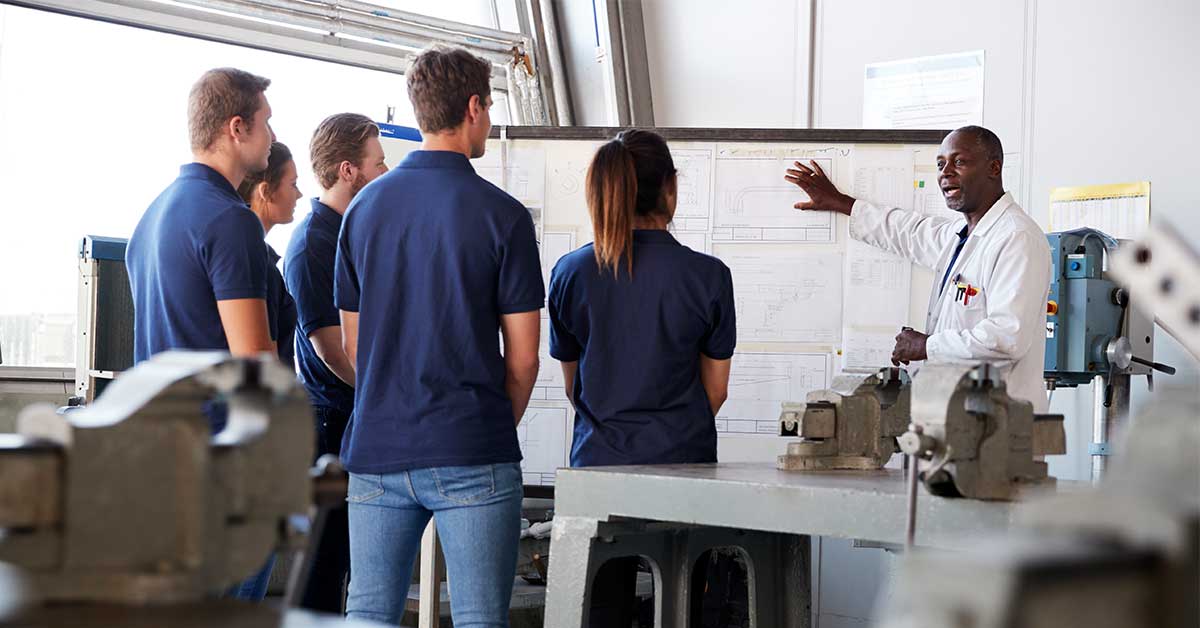
Imagine a bio-pharmaceutical manufacturing plant that also serves as a regional training hub. Classrooms are embedded inside the facility, and students—both high schoolers and adults—learn directly from professionals while earning wages. Instead of simulated labs, they work with the same materials, equipment, and data systems used in production. The employer gains a pipeline of trained talent, while the school gains access to world-class facilities without the cost of building them.
The same model applies to energy, technology, agriculture, and advanced manufacturing. Industry sites become economic development ecosystems, co-located with credentialing programs that connect directly to universities and technical colleges. Students earn micro-credentials, certifications, or college credits as they complete projects and tasks that contribute to real-world production.
How It Works
- Shared Infrastructure: Factories and industry centers provide the space, tools, and mentorship that schools cannot afford to replicate.
- Embedded Education: Classrooms and labs exist within these centers, integrating STEM, data literacy, and technical education into the daily workflow.
- Compensated Learning: Students earn wages while they learn, reducing financial pressure and dropout rates.
- University Collaboration: Higher education institutions embed credentialing pathways—such as associate and bachelor’s credits—into the system.
- Recruitment Pipeline: Employers recruit directly from their on-site training programs, ensuring an immediate return on investment in their workforce.
This is not theory—it is a scalable, evidence-based model. A recent analysis by the Urban Institute (2022) found that companies engaged in apprenticeship-based education saw a 44% reduction in turnover and a 29% increase in productivity. The return on investment for every dollar spent on integrated training was $1.44, compared to $0.62 for traditional workforce development programs.
Real-World Proof
In Tennessee, the Volkswagen Academy in Chattanooga integrates manufacturing education with production. Students complete high school and earn associate degrees through onsite training, entering the workforce debt-free and in demand.
In North Carolina’s Research Triangle, bio-manufacturing firms collaborate with community colleges to train technicians inside active production sites, reducing workforce on-boarding time by 60% (North Carolina Biotech Center, 2023).
In Michigan, the Ford Rouge Electric Vehicle Center collaborates with local schools to integrate engineering and automation training directly within the factory. Students rotate through real manufacturing stations, earning industry credentials and full-time job offers before graduation.
These are not pilot programs—they are the beginning of a transformation.
The ROI and the National Imperative
For employers, this model slashes training costs, improves retention, and ensures immediate skill readiness. For students and families, it replaces debt with income and replaces theory with experience. For schools and universities, it provides access to cutting-edge labs without capital investment. For the nation, it creates a sustainable, domestic workforce capable of powering critical industries without dependence on foreign labor.
It is more than an education reform—it is a national security strategy. The Department of Commerce (2024) has identified workforce readiness as the top barrier to achieving U.S. supply chain independence. Without a trained domestic workforce, reshoring efforts in microchips, clean energy, and defense manufacturing will collapse under the weight of unfilled positions.
This model builds the bridge between education, employment, and economic sovereignty.
The Economic Development Ecosystem
When industries become schools, and schools become engines of production, the entire system transforms into a self-sustaining economic ecosystem.
- Businesses gain loyal, skilled workers and lower operating costs.
- Communities benefit from job creation, increased tax revenue, and higher youth retention rates.
- Universities evolve into credentialing partners that validate and scale learning outcomes.
- Students and families gain purpose, stability, and opportunity.
The traditional brick-and-mortar school system, designed for a 1950s workforce, cannot meet the needs of a 21st-century economy. The factory-school model is not a disruption—it’s an evolution.
It’s how America reclaims its workforce, rebuilds its middle class, and restores its competitive edge in a world where the line between education and work is increasingly blurred.
If we fail to act now, the reshoring boom will become a missed opportunity. If we succeed, the United States will not only rebuild its industries—it will reinvent how a nation educates, employs, and sustains its people.
The path forward is clear: move the schools to where the work is.
References
Government Accountability Office. (2023). Condition of America’s public school facilities report 2023. Washington, DC.
Lumina Foundation. (2024). Today’s student: Adult learners balancing work, family, and education. Indianapolis, IN.
National Association of Manufacturers. (2023). Manufacturing workforce and productivity report 2023. Washington, DC.
National Center for Education Statistics. (2024). Adult learner completion and persistence study. Washington, DC: U.S. Department of Education.
North Carolina Biotech Center. (2023). Biomanufacturing workforce readiness report. Research Triangle Park, NC.
U.S. Chamber of Commerce. (2024). Workforce trends and skills shortage analysis 2024. Washington, DC.
Urban Institute. (2022). Do employers earn positive returns to investments in apprenticeship? Findings from the American Apprenticeship Initiative.
U.S. Department of Commerce. (2024). Reshoring and domestic capacity workforce strategy report. Washington, DC.